Zur Navigation
Zum Inhalt
Kontakt
Menu
Find component
Overview Lean
Find component
Enter keyword
More Info
Brand
Display
Figma
Code
More Info
Divider
Display
Figma
Code
More Info
Icon
Display
Figma
Code
More Info
Text
Display
Figma
Code
More Info
Typograhpy
Basics
Figma
Code
More Info
Accordion
Container
Figma
Code
More Info
Autocompletion
Form
Figma
Code
More Info
Breadcrumb
Navigation
Figma
Code
More Info
Button
Action
Figma
Code
More Info
Buttonbar
Action
Figma
Code
More Info
Checkbox
Form
Figma
Code
More Info
Checkboxpanel
Form
Figma
Code
More Info
Chip
Form
Figma
Code
More Info
Contextmenu
Action
Figma
Code
More Info
Datepicker
Form
Figma
Code
More Info
Dialog
Container
Figma
Code
More Info
Fieldset
Form
Figma
Code
More Info
Fileselector
Form
Figma
Code
More Info
Filter
Form
Figma
Code
More Info
Header
Navigation
Figma
Code
More Info
Link
Action
Figma
Code
More Info
Loadingindicator
Indicator
Figma
Code
More Info
Menuitem
Action
Navigation
Figma
Code
More Info
Notification
Indicator
Figma
Code
More Info
Pagination
Navigation
Indicator
Figma
Code
More Info
Processflow
Navigation
Indicator
Figma
Code
More Info
Radiobutton
Form
Figma
Code
More Info
Radiobuttonpanel
Form
Figma
Code
More Info
Select
Form
Figma
Code
More Info
Sidebar
Navigation
Figma
Code
More Info
Slider
Form
Figma
Code
More Info
Status
Indicator
Figma
Code
More Info
Tab
Container
Navigation
Figma
Code
More Info
Table
Display
Figma
Code
More Info
Tag
Form
Figma
Code
More Info
Textarea
Form
Figma
Code
More Info
Textexpand
Indicator
Figma
Code
More Info
Textfield
Form
Figma
Code
More Info
Timefield
Form
Figma
Code
More Info
Toggle
Form
Figma
Code
More Info
Tooltip
Container
Figma
Code
More Info
Tree
Navigation
Figma
Code
More Info
Usermenu
Action
Navigation
Figma
Code
No search results were found.
Try using different or fewer search terms.
Principles
Foundation
Accessibility
Design System
Guidelines
Deutsch
Français
Italiano
English
Our design principles
User-centred
Recognisable
Inclusive
Reduced
Holistic
Self-explanatory
Task-oriented
Appropriate
SBB Brand portal
Logo
Digital clock
Rights of use
Base colors
Additional colors
Off brand colors
Icons
Timetable icons
Pictograms
About accessibility
Über diesen Guide
Contact
Further information
Product Owner
User Research
Interaction Design
Visual Design
Development
Content Design
Testing
What is a design system?
Designing
Coding
FAQ
Help
Process
Contribution
Contact
Overview
Base
Components
Overview
Releases
Design Tokens
Components
Overview
Base
Informations
Overview
Base
Components
Overview
App Icons
Power-Apps
Digital banner ads
SAP Design Guidelines
AI Design: Basics
Dialog
Overview
What does the component do?
Causes an action by the user for specific decisions.
When should the component be used?
When an action has to be confirmed by the user.
To display critical information that has to be confirmed by the user.
To request actions that has to be confirmed by the user.
To select decision options by the user.
Rules
Behaviour
Dialogs are displayed as modal windows in front of the application.
Dialogs disable all application functions and remain displayed until they have been confirmed, cancelled or a necessary action has been performed.
Dialogs are purposefully interruptive, so they should be used sparingly.
The dialog can be closed and thus the action cancelled in several ways:
via the 'X' on the right in the header of the dialog.
via a click on the 'glass' in the background
via a 'Cancel'-button (if available)
'ESC' key on the keyboard
Layout
The dialog has its own header, content area and button bar.
It should be prevented from scrolling. If it cannot be prevented, the header and button bar are sticky.
The primary action is placed to the left of the secondary action.
A 'glass' is displayed behind the dialog, thus blocking editing outside the dialog.
Content
The header may contain context-describing information (e.g. the train number).
The content of the dialog can be used completely flexibly, e.g.
a detailed description of the situation and a clear question to be answered by the user.
a form to create or edit a complex data object.
Actions
Confirmation actions are disabled until a selection is made or the form is valid (all mandatory fields filled and no incorrect entries).
Cancel actions are never disabled.
Variants
Variants
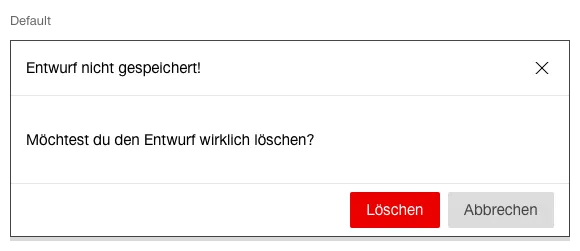
Simple (Warnings / Confirmations)
This variant has following states:
Default
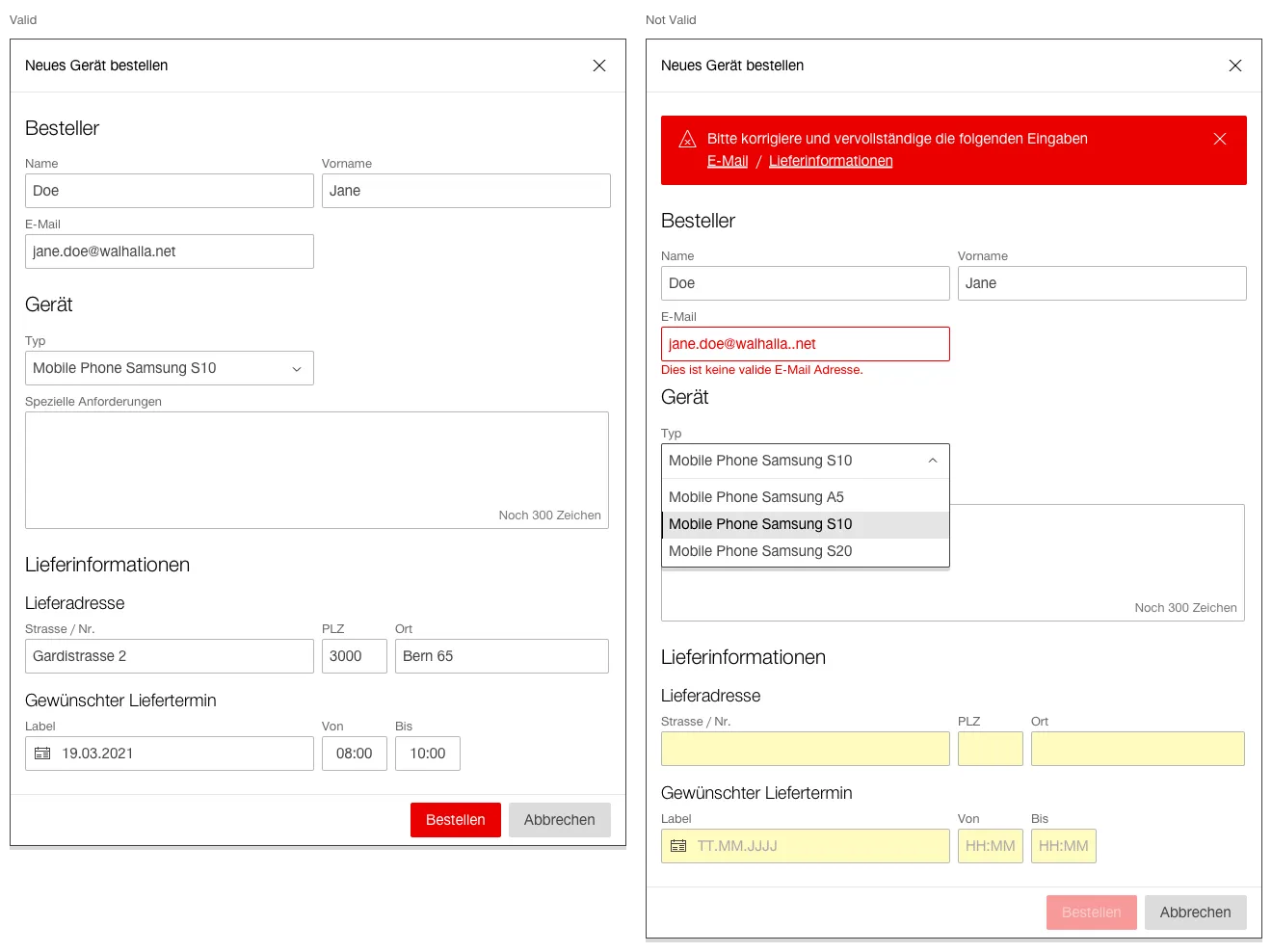
Complex (Forms)
This variant has following states:
Valid
Not Valid
The complex variant is used to create or edit complex data objects if they cannot be edited directly in the content of the application.
If the user wants to dismiss the dialog and ...
no changes have been made, the dialog closes and no discard confirmation is required.
the user has made changes, the user is prompted to confirm the discard action.
Specifications
Design
Code